
The Oxford Comma Is the Least Interesting Thing About Copyediting
I have serious thoughts about the Oxford comma, but they might not be what one would expect. My friend Julie knows my actual position, which is why she bought me a RAYGUN shirt that says SERIOUS ABOUT THE OXFORD COMMA.
Whenever I wear it, however, people understandably take it as a declaration of allegiance. They tell me how much they love the Oxford comma or bring up Eats, Shoots & Leaves, although that joke isn't actually about the Oxford comma. Either way, I’ve been invited into a conversation that would require an unreasonably detailed explanation of my actual position.
It's weird to correct strangers about what your punctuation shirt means, and explaining appositives in line for coffee seems like a good way to ruin somebody else's morning, so I generally don't.
Fortunately, I now have a chapblog.
A terminology note: I typically call it the serial comma, also known as the Oxford comma and, occasionally, the Harvard comma. Those institutional names lend a certain prestige—and maybe a little stodginess—to a fairly ordinary piece of punctuation. “Serial comma” is less glamorous, but it has the considerable advantage of telling us what the thing actually is. (I’ve now included all three variants for SEO purposes, so everyone wins.)
Fifteen years is enough
The Oxford comma has somehow become not just a punctuation preference but a personality trait. This isn't particularly new: in 2011, when the internet briefly believed Oxford had abandoned its namesake comma, people took to Twitter to announce their distress. One lamented having “strong feelings” about the development; another declared that the Oxford comma was what separated humans from animals.
Since then, we've put it on mugs, shirts, dating profiles and, yes, our bodies.
I don't begrudge anyone a beloved comma. I do think that after roughly 15 years of announcing our allegiance to it, we might be ready to discuss something more interesting—particularly because the argument everyone uses to demonstrate its indispensability doesn't actually demonstrate that.
You know the one:
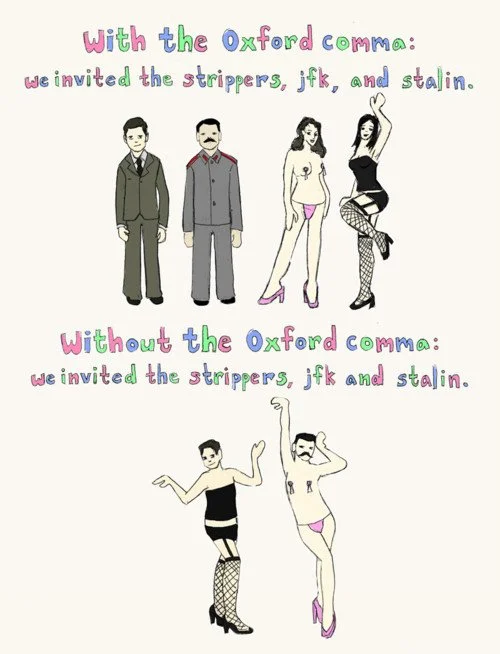
“Strippers, JFK, and Stalin,” via Jeff Bishop, September 18, 2011.
The familiar example makes its case by contrasting “We invited the strippers, JFK and Stalin” with “We invited the strippers, JFK, and Stalin.” Without the serial comma, JFK and Stalin can be read as an appositive identifying the strippers. With it, the intended three-part series becomes clear.
The same problem can arise in a dedication:
I'd like to thank my parents, Socrates and Megan Thee Stallion.
This is either an unconventional acknowledgment of two major intellectual influences or a revelation about the most chronologically improbable family in human history.
I'd like to thank my parents, Socrates, and Megan Thee Stallion.
Here, the serial comma is useful. I would use it. My objection has never been that the comma is bad; it's that the comma is not inherently clarifying.
In fact, someone found the problem with the famous example almost immediately. When the cartoon appeared on Language Log in September 2011, the first commenter changed exactly one word:
We invited the stripper, JFK, and Stalin.
Change strippers to stripper, and the serial comma now permits the very appositive reading it eliminated in the original: JFK may be one of three invitees, or JFK may be an appositive identifying the stripper. The punctuation hasn't eliminated the ambiguity; changing the position of a possible appositive has simply moved it.
Neal's rebuttal
Years ago, my friend Neal Obermeyer, an editorial cartoonist whose work has appeared in the Lincoln Journal Star and San Diego Reader, drew a rebuttal to the JFK-and-Stalin illustration that I've remembered ever since.
Editorial cartoon by Neal Obermeyer. Used with permission.
Neal simply moved the appositive problem.
Consider:
I had dinner with my dentist, Tina Fey, and my mechanic.
If those are three items in a series, I had three dinner companions. But Tina Fey can just as readily be an appositive identifying my dentist, in which case there were only two.
The Oxford comma hasn't eliminated the ambiguity; in this construction, it permits it.
Neal later explained that his cartoon wasn't really an argument against the Oxford comma any more than the original was an argument for it. Both illustrations show that appositives can occur in inconvenient places. As he put it, his was “more an argument against dumb arguments.”
That is considerably closer to my position.
So do I use the Oxford comma?
Yes. And no.
I follow the applicable style. If the house style calls for serial commas, I use them; if it doesn't, I don't. Either way, I make an exception when following the rule would introduce ambiguity, because consistency is useful only until it interferes with meaning.
That principle isn't unique to serial commas. Consider a no-Oxford-comma style applied to:
The choices were bacon and eggs, fish and chips and macaroni and cheese.
Technically consistent, perhaps, but needlessly difficult to parse. I would write:
The choices were bacon and eggs, fish and chips, and macaroni and cheese.
Oxford University's own style guide generally omits the serial comma but explicitly calls for one when it is necessary to prevent ambiguity.
That's editing. Style gives us defaults; syntax, context and readers occasionally give us reasons to depart from them. (No serial comma there. Wasn’t that perfectly easy to understand?)
There are so many better things to argue about
I don't want to take the Oxford comma away from anyone. I would simply like to suggest that punctuation and grammar contain more interesting controversies.
We could redirect some of this energy toward the semicolon, which people have been declaring pretentious for reasons I've never understood; the comma splice, whose absolute prohibition becomes considerably less absolute once you start reading accomplished writers; or the em dash, which is currently having an identity crisis of its own.
Better yet, we could talk about syntactic ambiguity, garden-path sentences, attachment, restrictive versus nonrestrictive modification, or any of the other places where grammar becomes substantially more interesting than deciding whether a comma belongs before and.
Keep your Oxford comma. Put it on your mug. Tattoo it on your body if you must.
Just don't ask it to solve a syntactic problem it didn't create.
Agree? Disagree? Tell me why.
